What You'll See on a Charleston Harbor Dinner Cruise
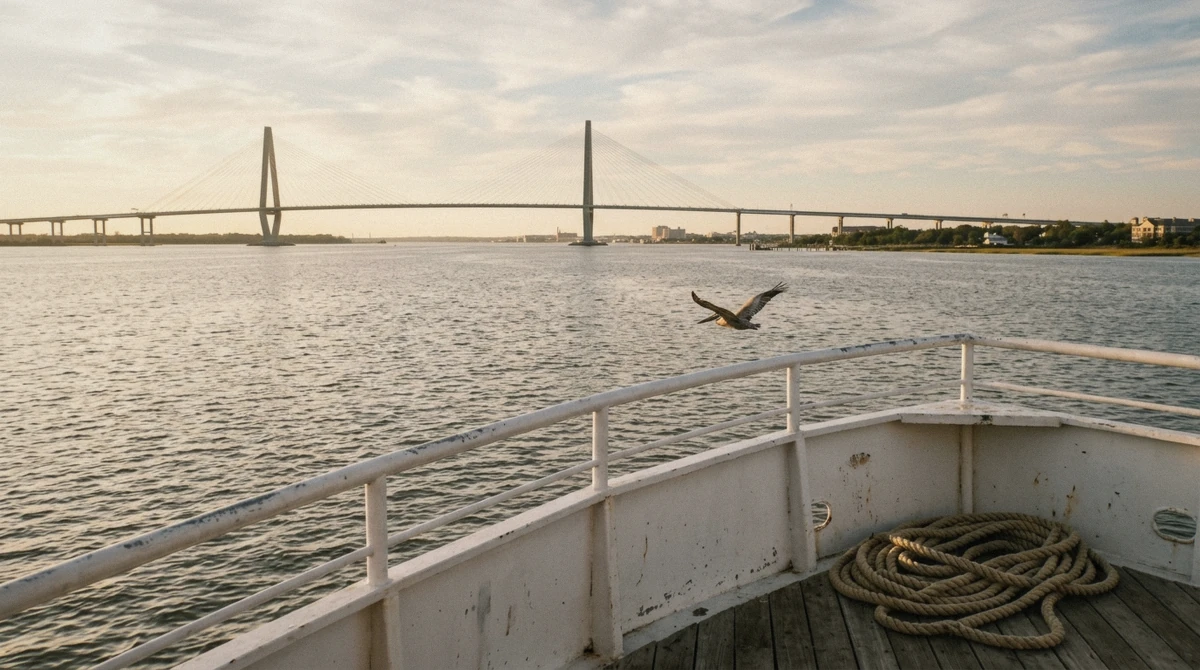
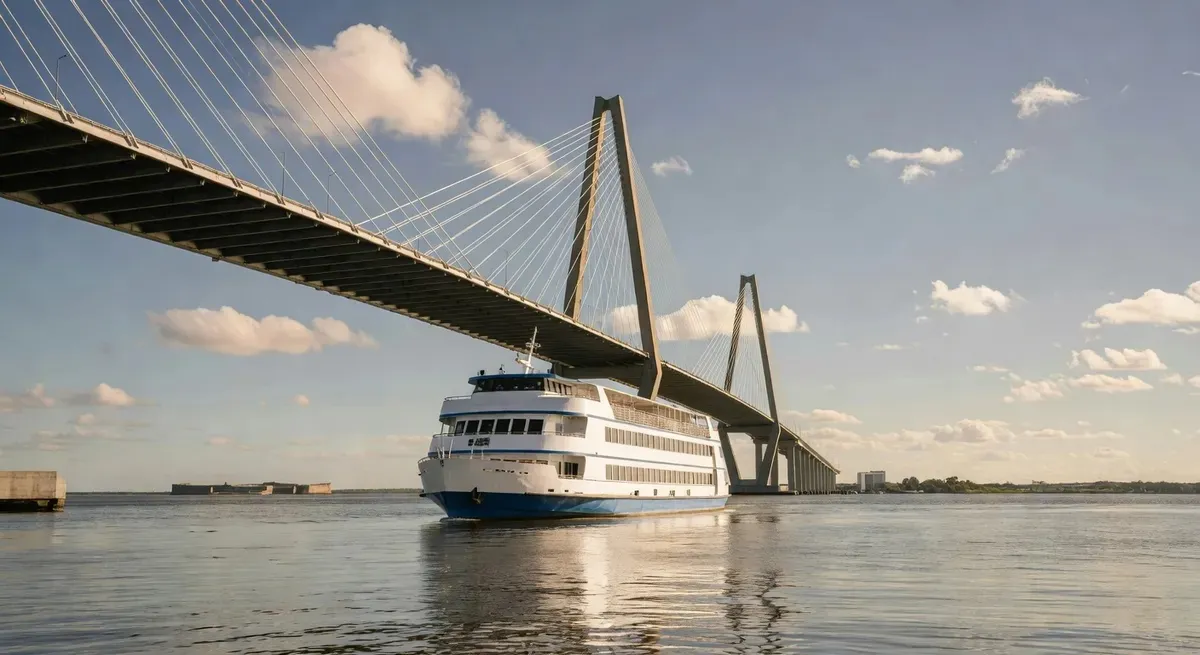
What you'll see on a Charleston Harbor dinner cruise is a working waterway before it's a tourist route, and that's exactly what makes the 2.5-hour loop worth the rail time between courses. The boat threads past a Civil War fort, a decommissioned aircraft carrier and a bridge tall enough to carry container ships underneath, then hands the rest of the evening to whatever wildlife happens to be working the water that night. We get asked constantly what's actually visible from the deck, so this is the honest answer, tier by tier, with a map.
Quick answer
Every sailing passes the Arthur Ravenel Jr. Bridge, Fort Sumter, the USS Yorktown and the Battery, all visible from the rail without the boat ever leaving the main channel. Most evenings add bottlenose dolphins and brown pelicans working the wake, and on a lucky evening one of those dolphins will ride the bow spray close enough to see clearly.
Key takeaways
- The Arthur Ravenel Jr. Bridge and Fort Sumter pass on every sailing, whichever boat you pick
- Bottlenose dolphins show up on most trips in the warm months, alongside brown pelicans on nearly every one
- The Luxury 3-Course Dinner Cruise and the BBQ boat run the same harbor loop, so the sights don't change with the menu
- For the best light on the bridge towers and the Battery, see when the sun actually sets by month before you book a date
- Fort Sumter is a sail-past, not a stop, and the map below marks exactly where it sits on the loop
- The full breakdown of what the cruise is actually worth beyond the view is in our is the harbor cruise worth it guide
The Harbor at a Glance
Every sight on the loop, ranked by how often it actually shows up. Last verified: August 2026, against current operator routes and the harbor's resident dolphin population.
| Sight | Where on the loop | Best light | How likely |
|---|---|---|---|
| Arthur Ravenel Jr. Bridge | Just off Seabreeze Marina, first ten minutes | Blue hour, towers lit after dark | Nearly every trip |
| Brown pelicans | Working the whole channel, especially near pilings | Any time, best in low sun | Nearly every trip |
| USS Yorktown, Patriots Point | Cooper River side, opposite the bridge | Late golden hour | Nearly every trip |
| The Battery / White Point Garden | Peninsula tip, on the return leg | Sunset, city lights after dark | Nearly every trip |
| Castle Pinckney | Shutes Folly island, mid-harbor | Late afternoon light on the brick | Nearly every trip |
| Fort Sumter (sail-past) | Open harbor, roughly three miles out | Silhouette at sunset | Nearly every trip |
| Bottlenose dolphins | Anywhere in the channel, often near the wake | Daylight, easier to spot before dusk | Most trips in warm months |
| Container ships, Port of Charleston | Main shipping channel, harbor mouth | Any time | Regular but not every trip |
| Ospreys on nest platforms | Channel markers and pilings near the marina | Morning and early evening | Regular but not every trip |
| A dolphin bow-riding the wake | Right off the bow, close enough to see clearly | Any time it happens | Lucky-day sighting |
Read straight down that table and a pattern shows up fast: the built landmarks are the reliable half of the evening, and the wildlife is the variable half. The bridge, the fort, the carrier, Castle Pinckney and the Battery don't move and don't have a season, so they pass on essentially every sailing regardless of weather or time of year. The dolphins and the birds are real animals doing what real animals do, which means most evenings deliver them and a few don't.
We'd rather say that plainly than print a brochure line promising sightings that falls apart the first time a table asks about it.
Map of the Harbor Loop
The two boats run the same basic loop (the BBQ boat casts off from Seabreeze Marina, the luxury boat's dock comes with your booking confirmation), so the pins below apply equally aboard the Sunset Blues & BBQ Dinner Cruise or the Luxury 3-Course Dinner Cruise. The route bends around the peninsula and back, which is why landmarks on opposite sides of the harbor both end up passing the rail over the course of 2.5 hours.
On Every Sailing
Arthur Ravenel Jr. Bridge
The cable-stayed bridge over the Cooper River is the first thing most passengers photograph, usually within the first ten minutes out of Seabreeze Marina. Its two diamond-shaped towers carried the longest cable-stayed main span in North America when the bridge opened in 2005, and they hold that record's legacy in the harbor's skyline more than a decade after several longer spans opened elsewhere. What most first-time riders don't know is that the towers run a subtle after-dark lighting sequence that changes with the season, something you only notice if you've made the loop more than once.
Fort Sumter
Fort Sumter sits about three miles out in open harbor, and it's where the first shots of the Civil War were fired in April 1861. Day ferries run passengers out to walk the grounds, but the dinner cruise does not dock there. What you get instead is a clean silhouette against the evening sky, close enough to make out the fort's low profile and the flag above it, which for most tables is plenty.
We'll cover the docking question properly below, since it trips up more people than any other stop on the loop.
USS Yorktown at Patriots Point
The USS Yorktown is a Second World War Essex-class aircraft carrier that's sat as a museum ship at Patriots Point since 1975, moored across the Cooper River from downtown. From the water its flight deck reads as an enormous flat shelf against the shoreline, a scale that's hard to appreciate from land. Late golden hour throws long shadows across the deck edge that make the whole ship look like it's still underway.
Castle Pinckney
Castle Pinckney is a small 1810 masonry fort on Shutes Folly, a low island in the mid-harbor most land-based visitors never see up close, because it's closed to the public. It never fired a shot in anger in its working life, which locals mention more as a curiosity than a footnote. The water is genuinely the best vantage point for it, since there's no public dock or trail on the island itself.
The Battery and White Point Garden
The Battery is the antebellum promenade at the very tip of the peninsula, backed by White Point Garden's mansion row and a scatter of Civil War cannons still aimed out at the water. It's the last major landmark on the return leg, which means it usually catches the boat right around sunset in spring and fall. The cannons are original artillery pieces, not reproductions, something guides on the walking tours point out more than the boat crews do.
Most Evenings
Bottlenose dolphins
A year-round resident population of bottlenose dolphins lives in Charleston's harbor and estuary, and bottlenose dolphins show up on most trips in the warm months, usually working the wake or feeding along the channel edges rather than performing for the boat. They're easiest to spot in daylight, before the sky gets too dark to pick out a fin against the water. Watch the wake directly behind the stern first; that's where they tend to appear before anywhere else.
Brown pelicans
Brown pelicans are close to a certainty on this route, gliding low over the channel in loose lines or perched on channel markers and pilings near the marina. They're easy to identify even for a first-timer: a long bill, a heavy prehistoric silhouette, and a low, efficient glide just above the waterline. Watching one fold its wings and drop straight into the water after a fish is one of the more reliably entertaining five seconds of any evening on the harbor.
Container ships
The Port of Charleston runs one of the busiest container operations on the East Coast, and a ship moving through the main shipping channel during the cruise's window is regular but not every trip. When one does pass, the size difference next to the dinner boat is dramatic enough that entire tables stop mid-conversation to watch it go by. Ask a deckhand and most can tell you roughly what's coming through that week.
Ospreys
Ospreys nest on platforms scattered around the harbor's channel markers and pilings, and sightings are regular but not every trip. They're a different silhouette from the pelicans: narrower wings held in a distinct bend, and a habit of hovering briefly before a dive. Boarding thirty minutes early rather than right at the marina buys extra time near the pilings closest to the dock, which is where we've had the best luck spotting one perched rather than in flight.
On a Lucky Evening
Every so often the harbor delivers something beyond the reliable list above, and it's worth setting expectations honestly rather than promising it.
A dolphin bow-riding the wake
On a genuinely lucky evening, one of the harbor's resident dolphins will tuck in right at the bow and ride the pressure wave the boat pushes ahead of itself, close enough to see the eye and the scars some of them carry from boat traffic over the years. It's a lucky-day sighting, not something you can plan a table around, but when it happens it tends to be the thing everyone talks about on the drive home. If you want the best odds, stand at the bow rail rather than midship during the first thirty minutes out of the marina, when the boat is moving at its steadiest speed.
Which Side of the Boat to Stand On
This is a loop, not an out-and-back, so both sides of the boat get a turn facing the interesting stuff over 2.5 hours. That said, the two sides do trade off in a way worth knowing before you pick a table.
The harbor side, facing the Cooper River and the marshes toward Mount Pleasant, gets the Ravenel Bridge and the USS Yorktown early, plus most of the dolphin and pelican activity, since the wildlife tends to work the wider, calmer water on that side of the channel. The peninsula side, facing downtown Charleston, gets the skyline itself, Castle Pinckney at closer range, and the Battery on the return leg, plus the better sunset light in the shoulder seasons when the sun sets behind the city.
If you can only pick one rail to camp at for the whole evening, the upper open deck beats either side of the enclosed dining level, since it lets you cross from rail to rail as the boat swings around the loop instead of committing to one view for 2.5 hours.
What You Won't See
The most common mix-up we hear at the dock is a guest expecting to walk the grounds at Fort Sumter the way day-trip ferry passengers do. The dinner cruise does not dock at Fort Sumter, and it never has; it's a sail-past at a respectful distance, not a stop. The confusion is understandable, since Fort Sumter's day ferries leave from a different dock entirely and are a completely separate booking with a completely separate purpose.
What the dinner cruise gives you instead is the fort's silhouette against the evening sky, from open water, at the hour when the light does most of the work anyway. If walking the actual fort grounds matters to your trip, that's a Fort Sumter ferry ticket booked separately, not something either dinner cruise substitutes for.
Landmark and Best Photo Moment
If you're choosing where to point a camera rather than where to stand, this is the shortlist.
| Landmark | Best photo moment |
|---|---|
| Arthur Ravenel Jr. Bridge | First ten minutes out, towers backlit at blue hour |
| USS Yorktown | Late golden hour, long shadows across the flight deck |
| Castle Pinckney | Late afternoon light hitting the old brick walls |
| Fort Sumter | Clean silhouette right at sunset |
| The Battery | Sunset into the return leg, city lights coming on behind the cannons |
When the Light Is Best
Sunset timing shifts the whole evening more than any other single variable. In summer, sunset lands mid-cruise, so you get the golden hour somewhere around the halfway mark rather than at the very end. In October, sunset falls close to boarding, which stacks all the best light right at the start.
From November through February, the sun is down well before either boat leaves the dock, so those evenings trade sunset color for city lights and the bridge towers lit up against full dark instead. None of those trade-offs are bad, they're just different evenings, and our best time for sunset on the water guide breaks down exactly what to expect by month.
How to Catch the Most from the Deck
A few things we've picked up from doing this loop more times than we can count.
- Board when the gate opens rather than right at departure. Both boats open boarding thirty minutes before departure, and the extra time buys first pick of rail space before the deck fills in.
- Keep your phone or camera ready during the first ten minutes out of the marina. That's when the Ravenel Bridge is closest and the light is often still workable.
- Watch the wake, not the horizon, if you're hoping for dolphins. They tend to surface behind the stern before they show up anywhere else.
- Don't camp on one side of the boat for the full 2.5 hours. The loop shape means the interesting view genuinely does swap sides partway through.
- If a container ship is moving through the channel, deckhands usually know about it before it's visible. Ask early rather than hoping to spot it yourself.
- Bring a light layer even in summer. Once the boat is moving, the breeze off open water runs noticeably cooler than the dock did.
Frequently Asked Questions
Which side of the boat is better for photos?
Neither side wins outright since it's a loop. The harbor side gets the bridge and most of the wildlife activity early; the peninsula side gets the downtown skyline, Castle Pinckney and the Battery on the return leg. The upper open deck lets you move between rails as the boat turns.
Can you visit Fort Sumter from the dinner cruise?
No. The dinner cruise sails past Fort Sumter at a distance and does not dock there. Walking the fort grounds requires a separate day ferry ticket that leaves from a different dock entirely.
When do dolphins typically appear on the cruise?
Bottlenose dolphins live in the harbor and estuary year-round, and sightings are most common in the warm months, usually in the wake behind the boat or along the channel edges. They show up on most trips in season, not every one.
What's the best time of evening to see the bridge lit up?
After dark, once the Ravenel Bridge's tower lighting has come on. In the shorter-daylight months of November through February that happens before the boat even leaves the dock; in summer it's usually visible again on the return leg.
How likely are you to see a container ship in the harbor?
Regular but not every trip. The Port of Charleston runs a busy container operation, and ships move through the main channel often enough that most weeks see at least a few passes during the cruise window, though not every single sailing.
Where's the best spot on the boat to watch for wildlife?
The stern rail, watching the wake directly behind the boat. Dolphins tend to surface there first, working the water the propellers stir up, before showing up anywhere else on the loop.
The honest version of this guide is that the built landmarks do the heavy lifting and the wildlife is the bonus, not the other way around. Compare the Charleston evening cruise options side by side before you pick a date, since the loop and the sights are the same on both boats and the real differences are the meal, the price and the deck.